You don’t need a new diet—you need to see your day clearly
You can eat “pretty healthy” and still feel foggy by 3 p.m., snack more than you planned, and watch your labs creep the wrong way. It usually isn’t because you need a new set of rules. It’s because your day has hidden patterns: a short sleep night, a long sit, a late lunch, a stressed commute, then a big dinner.
Diet plans miss this because they average your week. Your body reacts to the rough days. Meetings shift meals, screens push bedtime, and workouts become an all-or-nothing fix.
The faster move is to see your day clearly enough to spot the repeat points where things slide.
Why the ‘pretty healthy’ week still produces metabolic warning signs
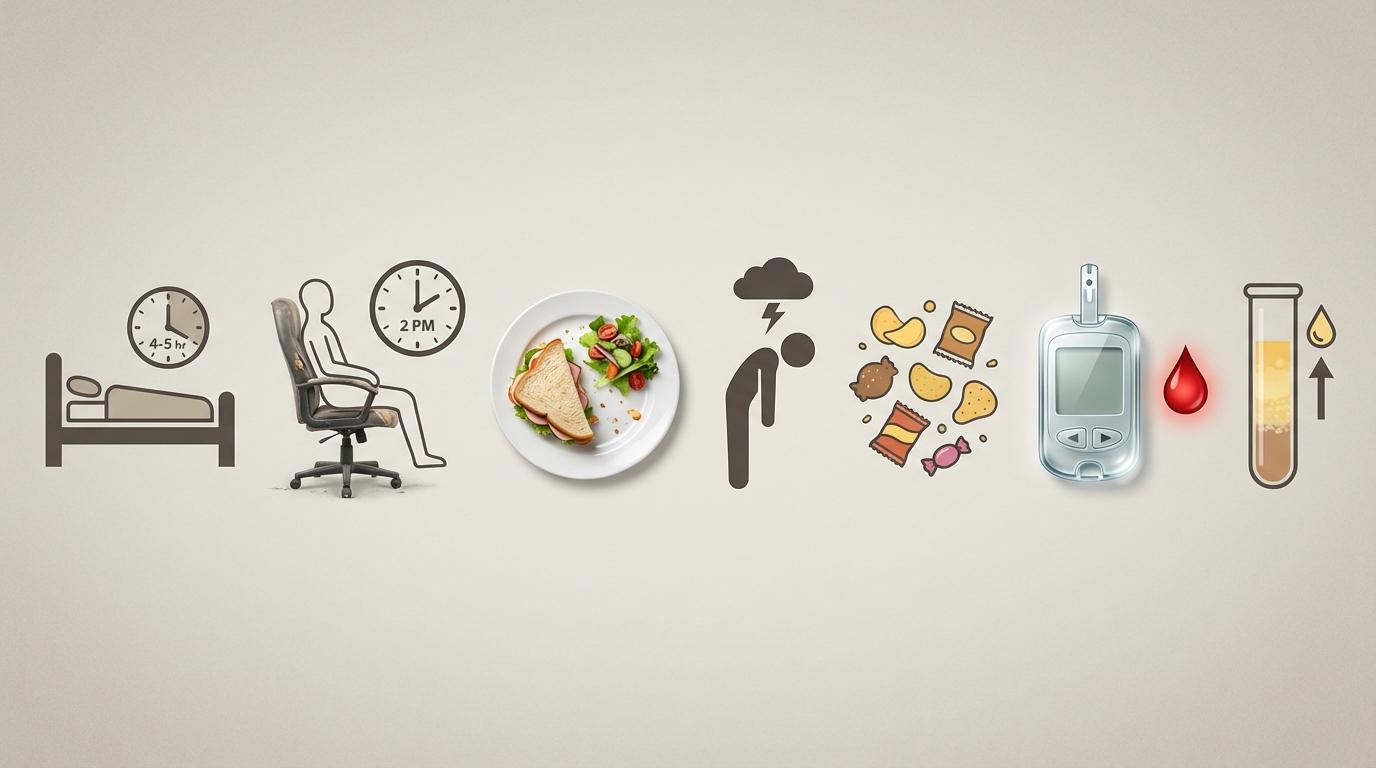
Those repeat points are why a “pretty healthy” week can still end with higher fasting glucose, rising triglycerides, or a waistband that won’t budge. A few days of short sleep, a couple of long sitting blocks, and one or two late, rushed meals can change how hungry you feel, how steady your energy runs, and how your body handles carbs the next morning.
If you eat a solid breakfast and salad lunches Monday through Thursday but crash at 4 p.m., the fix usually isn’t a stricter menu. It’s the pattern that sets up the crash: you slept 6 hours, didn’t move until noon, then pushed lunch to 2:30. When that happens, snacks become a “solution,” dinner gets bigger, and bedtime slides again.
The trade-off is annoying but useful: weekly averages feel reassuring, but daily swings create the warning signs you’re trying to stop.
Run a 24-hour replay: where your routine actually goes off-script
Daily swings are easier to fix when you can point to the exact moments they start. Picture a normal workday and run it like a replay: wake time, first caffeine, first food, longest sitting stretch, when stress peaks, when you last ate “real” food, and when screens end. Most people don’t go off-script at dinner—they go off at 10 a.m. when breakfast is light, at 1 p.m. when lunch gets pushed, or at 8 p.m. when the day finally slows and snacks fill the gap.
Keep it simple: write a timeline from wake-up to bedtime and mark three things—sleep length, meal timing, and movement breaks. Add quick notes like “hungry at 11,” “coffee instead of food,” “meeting ran long,” or “picked up takeout.” The friction you’ll hit is honesty: the day will look “fine” until you include the unplanned bites and the two-hour sit that turned into five.
Your goal isn’t perfection. It’s finding the two repeat points that show up on your rough days.
The sleep window you keep missing—and how it shows up as hunger tomorrow
Those repeat points often start the night before, when bedtime slides “just a little” and you still have to wake up at the same time. You don’t always feel it at breakfast. You feel it mid-morning when you’re hunting for something sweet, or at 3 p.m. when your focus drops and snacks look like a fix. The next day can also push your first meal later, which turns lunch into a scramble and makes dinner bigger without you planning it.
What’s usually missing isn’t sleep in general—it’s a consistent sleep window. If you’re in bed at 11:30 one night and 1:00 the next, your hunger cues and energy won’t stay steady, even if total hours look “okay” on paper. Protecting that window can mean ending screens earlier or leaving a task half-done.
To spot it, pair each rough hunger day with the night before: lights-out time, wake time, and how long it took to fall asleep. Then you’ll know whether tomorrow’s cravings started in your inbox tonight.
When lunch is late and snacks take over: what to change first

When tomorrow’s cravings start in your inbox tonight, lunch often becomes the next domino. A meeting runs long, you look up and it’s 2:30, and “just something quick” turns into vending-machine snacks or desk bites that don’t feel like a meal. Then you hit late afternoon hungry, dinner gets bigger, and you end up eating close to bedtime.
The first change isn’t a better snack list. It’s putting a guardrail on lunch timing. Pick a latest-lunch cutoff (for many people, 1:00–1:30) and treat it like a calendar block. If you can’t get a full meal, use a “bridge” you can keep at work: Greek yogurt and fruit, a turkey sandwich, leftovers, or a protein-forward smoothie. You’ll sometimes eat before you feel “ready,” but you’ll prevent the snack spiral.
Watch one signal: are you less hungry at 4 p.m. the next day?
If you sit for hours, the gym can’t fully ‘cancel it’
That 4 p.m. hunger is also more likely when your day has long, unbroken sitting blocks, even if you hit the gym after work. The common pattern is simple: you sit through the morning, sit through lunch, sit through the afternoon, then try to “make up for it” with a hard 45-minute workout. It helps, but it doesn’t rewind the hours your muscles stayed mostly idle.
If you’re sitting 6–10 hours, your body has fewer chances to use circulating sugar and fat during the day, so energy and cravings can feel less steady. A practical fix is boring but effective: add short movement breaks that happen before you feel stiff. Stand for calls. Walk 5 minutes after lunch. Set a timer for 30–60 minutes and do 1–2 minutes of walking, stairs, or light bodyweight moves.
The friction is social and logistical: you’ll worry it looks odd or you’ll lose focus. Make it small enough that you’ll actually do it, then keep an eye on whether the afternoon crash softens.
Pick 2–3 changes to test for 3 weeks—and choose the signals you’ll watch
Once the afternoon crash softens, the temptation is to stack fixes. That usually backfires, because you can’t tell what helped, and the new routine gets too hard to repeat on a busy week. Instead, pick 2–3 changes that hit your repeat points and run them for three weeks. Keep them specific: “lights out by 11:30 on weeknights,” “lunch by 1:30 with a real protein,” “two 5-minute walks—one mid-morning, one after lunch.” If your changes need willpower every time, they won’t survive a rough Tuesday.
Then choose 2–3 signals to watch, not ten. Aim for signals you’ll notice without extra work: how hungry you feel at 11 a.m. and 4 p.m., whether you need caffeine to stay sharp after lunch, and whether you snack after dinner. If you track numbers, add one: morning weight or fasting glucose a few days per week. You’re testing patterns, not chasing a single “good” day.
After three weeks, keep what made weekdays easier and drop what only worked when life was quiet.
A routine you can repeat beats a perfect plan you can’t
Keeping what made weekdays easier usually means choosing the version you can do on your busiest week, not your best week. A “perfect” plan often fails on Tuesday: a late meeting, a kid pickup, a rough night of sleep, and suddenly the rules don’t fit. That’s not a character issue. It’s a design issue.
Build a routine with defaults and backups. If lunch gets pushed, use your bridge meal. If you miss the gym, take two short walks and keep bedtime steady. The trade-off is you’ll do less than you think you “should,” but you’ll do it more often. Repeatable wins change your numbers. Perfection just changes your mood.